Last updated: November 2026
Driving in Iceland is the most flexible way to see the country, and most visitors manage it well with some preparation. Traffic drives on the right, headlights stay on day and night, and speed limits are 90 km/h on paved roads, 80 km/h on gravel and 30 to 50 km/h in towns. Driving off marked roads is illegal.
The road rules are easy to learn. Conditions are what make Iceland different: weather that changes within hours, strong wind, gravel roads, single-lane bridges and, in the colder months, ice and snow. This page covers the basics you need before you start. Each section links to a detailed guide.
90 km/h
Paved roads outside towns
80 km/h
Gravel roads
30–50 km/h
In towns
Iceland driving rules at a glance
Iceland’s traffic rules are close to those in most of Europe and North America, with a few differences that catch visitors out: no right turn on red, headlights on at all times and a special priority rule in two-lane roundabouts.
Is driving in Iceland hard?
For most drivers, no. Traffic outside Reykjavík is light, and the Ring Road (Route 1) is paved all the way around the country. The challenge is conditions rather than traffic. If you slow down, check the forecast and road status each morning, and keep your plans flexible, driving in Iceland is manageable even for first-time visitors.
The hazards to know about
Paved roads turning to gravel
Slow down before the surface changes. Many accidents happen at this point because tires lose grip.
Single-lane bridges
They appear on main roads too, including parts of the Ring Road. Slow down early and give way if the other car is closer.
Blind hills and bends
Signs marked Blindhæð warn of a hill crest you cannot see over. Keep right and reduce speed.
Sheep and horses
From spring to autumn, sheep graze freely next to and on the road. If you see a lamb on one side and a sheep on the other, slow right down.
Strong wind
Gusts can push a car sideways and tear a door open. Check wind warnings, park facing into the wind and hold the door with both hands. Camper vans and high vehicles are most exposed.
Stopping for photos
Never stop on the road or the shoulder. Use marked parking areas and viewpoints.
Tiredness after a night flight
Many flights land early in the morning. Rest before a long drive instead of setting off straight from Keflavík International Airport (KEF).
Short winter days
Around the winter solstice (21 December), Reykjavík gets only about 4 hours of daylight. Plan each day so you reach your accommodation before it gets fully dark.
Navigation apps
Map apps do not always show closed or impassable roads. Check road.is before you rely on a route.
Check these sources before you drive each day
Conditions can change between breakfast and lunch, so make these checks part of your morning routine:
Road conditions, closures and webcams from the Icelandic Road and Coastal Administration.
Weather forecasts and wind warnings from the Icelandic Met Office.
Alerts and the travel conditions map from ICE-SAR. The Safetravel app sends alerts to your phone.
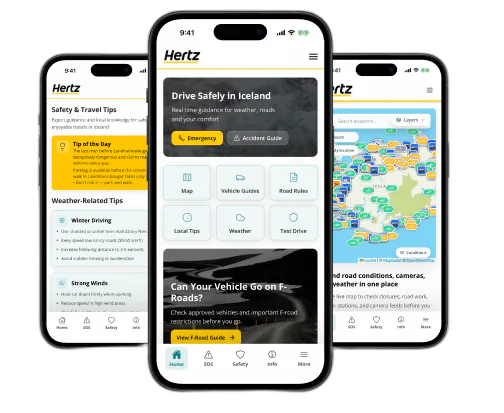
safe.hertz.is and the Safe Drive Iceland app
Hertz Iceland’s all-in-one safe-driving website and app for self-drive travellers in Iceland. Download it from the App Store or Google Play.
A road sign reading Lokað means the road is closed. Do not drive past it.
Iceland’s roads and seasons
Iceland has three types of road: paved roads, gravel roads and F-roads (mountain roads in the highlands).
Ring Road (Route 1)
About 1,320 km, paved the whole way and open all year. Winter storms can close sections for hours or days.
Gravel roads
Common away from the Ring Road. A regular car can drive them. The speed limit is 80 km/h, but drive slower on loose or washboard surfaces.
F-roads
Unpaved highland roads that usually open in June and close in September. Opening dates vary by year and by route, so check road.is.
F-roads and river crossings
F-roads are only for suitable 4×4 vehicles. With a Hertz rental:
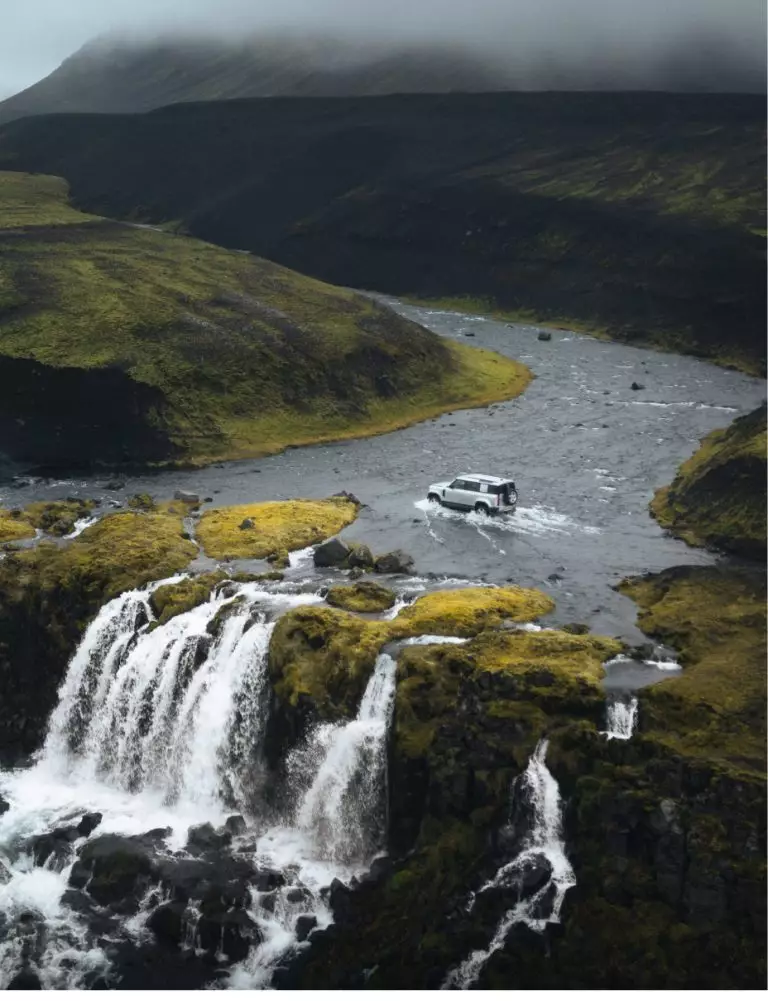
Some F-roads cross unbridged rivers. No coverage product, including MAX Cover, covers river or water-crossing damage or underbody damage.
Driving in winter
Winter conditions can start in autumn and last into spring. Expect snow, ice and black ice, strong wind and short days. The Ring Road stays open, but storms can close roads at short notice.
You do not need a 4×4 for the Ring Road, but many travellers choose one in winter for extra traction on snow and ice. Tires, speed and timing matter more than the drive system: slow down, keep more distance than at home, and wait out a storm instead of driving through it. Icelandic law allows studded tires only from 1 November to 14 April, and Hertz follows this rule, so cars have studded tires only in that period.
Driving costs: tolls, road tax, parking and fuel
Tolls
Almost all roads in Iceland are toll-free. There are two toll points:
Vaðlaheiðargöng tunnel
Near Akureyri in North Iceland. Pay online at veggjald.is within 24 hours of passing.
Hornafjörður toll bridge
On the new Ring Road (Route 1) section near Höfn in Southeast Iceland, opened in June 2026. There is no toll booth. Pay online at spolur.is within 5 hours of passing.
Neither toll point has a booth or barrier, so it is easy to drive through without noticing. You pay tolls yourself. If a toll is not paid in time, Hertz pays it and charges you the toll plus an admin fee.
Road tax
6.95 ISK / km
Government road tax
1.40 ISK / km
Hertz service fee (+ VAT)
Since 1 January 2026, Iceland charges a kilometre-based road tax on all vehicles, including electric and hybrid cars. For a Hertz rental, this is 6.95 ISK per km government road tax plus a 1.40 ISK per km Hertz service fee (+ VAT). It is not included in the rental price and is charged after return, based on the kilometres you actually drove. Questions about road tax: roadtax@hertz.is.
Parking
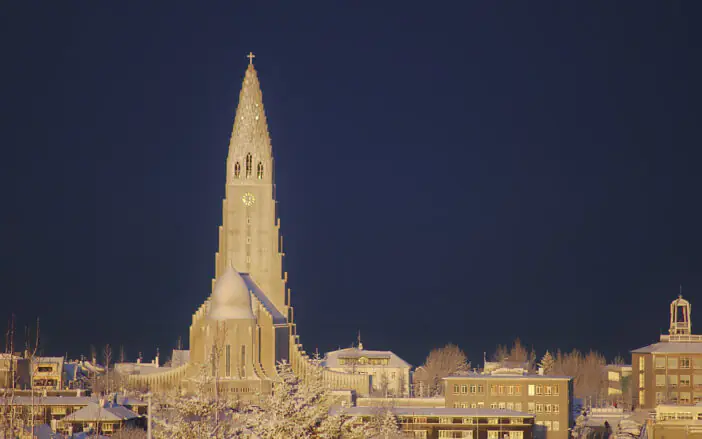
Parking in Reykjavík, Akureyri and at many popular sights is paid. A blue sign with a white P marks a parking area. Pay at the meter or with the Parka or EasyPark app. Unpaid parking leads to a ticket.
Fuel
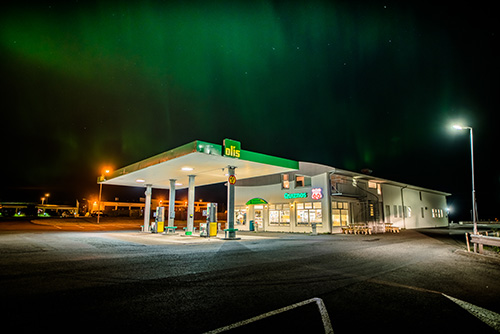
Gas stations are self-service, and most pumps take a credit or debit card with a PIN. You will find stations in towns and along the Ring Road, usually not far apart. On a few remote stretches, for example between small fjord towns, the next station can be up to about 100 km away, so fill up when you can. Hertz cars are rented full-to-full.
Tickets and fines
Speeding, parking, off-road driving and camping outside campsites all carry fines. Fines that reach Hertz after your rental are charged to you with an admin fee, and may be collected from the credit card authorization.

Driving an electric car, PHEV or Tesla in Iceland
Charging stations cover the Ring Road and most towns, so a road trip in an electric car or plug-in hybrid (PHEV) is practical with some planning. Cold weather, strong wind and steady driving at 90 km/h shorten the range, so charge with a margin, especially before remote stretches such as the Eastfjords and Westfjords.
Fully electric cars
A charging cable is included. Expect less range in winter. A cold battery also charges more slowly, so charge soon after driving, while the battery is still warm.
Fully electric cars are never allowed on F-roads.
Plug-in hybrids (PHEV)
A PHEV runs on electricity for shorter distances, then switches to the fuel engine, so you never depend on chargers alone. A charging cable is not included by default.
Most PHEV 4×4 models are allowed on F-roads, but some luxury models are not. Check the vehicle page.
Tesla
You do not need a Tesla account to use Tesla Superchargers. Hertz pays and charges you afterwards.
Regenerative braking slows the car as soon as you lift off the accelerator. On snow or ice, ease off gently.
The Tesla Model Y must be returned with at least 70% charge.
The kilometre-based road tax applies to electric and hybrid cars too.
What to know when you drive a Hertz rental car
At pick-up
The original physical driver’s licence, held for at least one year by every driver, and a physical credit card in the main driver’s name. Digital driver’s licences, photos of a licence, virtual cards and mobile wallets are not accepted.
International Driving Permit (IDP)
Needed if your licence is not in English or Roman script. Hong Kong and Taiwan licences always need an IDP or a notarized translation. Mainland China licences need the original licence plus a notarized translation; a standard translation is not accepted.
Age
The minimum rental age is 20. Some vehicles require 23, and luxury cars require 25. Each vehicle page shows its minimum age.
Coverage limits
No coverage product covers underbody damage, river or water-crossing damage, or damage from driving off marked roads.
Your costs on the road
Tolls, parking, fines and road tax are paid by the renter.
Before you arrive
Check in online at checkin.hertz.is.
What to do in an emergency
Injury or serious accident: call 112 immediately.
Driving in Iceland FAQ
What should I know before driving in Iceland?
Drive on the right, keep headlights on at all times and stay within 90 km/h on paved roads, 80 km/h on gravel and 30 to 50 km/h in towns. Turning right on red is not allowed. Never drive off marked roads. Check road.is and en.vedur.is every morning, because weather and road conditions change quickly.
Is driving in Iceland hard?
For most drivers, no. Traffic outside Reykjavík is light and the Ring Road is paved all the way around. The difficulty comes from conditions: fast-changing weather, strong wind, gravel roads, single-lane bridges and winter ice. Slow down, check conditions daily and keep your plans flexible, and most visitors find it manageable.
Is driving in Iceland the same as in Canada?
Mostly. You drive on the right, but road signs follow European standards. The main differences: no right turn on red, headlights on at all times, a 90 km/h maximum, and inside-lane priority when leaving two-lane roundabouts. Expect gravel roads and single-lane bridges, even on main routes.
Can I drive in Iceland with a Canadian driver’s licence?
Yes. Canadian licences are in English or French in Roman script, so you do not need an International Driving Permit (IDP). Bring the original physical licence, held for at least one year. If your licence is in another script, you need an IDP. Hong Kong and Taiwan licences always need an IDP or a notarized translation.
Do I need a 4×4 or AWD to drive in Iceland in winter?
Not for the Ring Road, which a regular car can drive in normal winter conditions. Many travellers still choose a 4×4 or AWD for extra traction on snow and ice, but a 4×4 does not stop you sliding on ice. Studded tires are allowed from 1 November to 14 April. F-roads need a suitable 4×4.
Is it safe to drive in Iceland in October, November or March?
Yes, with preparation. These months can bring snow, ice, strong wind and short days. Studded tires are allowed only from 1 November to 14 April, so take extra care with early snow in October. Plan shorter driving days, check road.is and en.vedur.is each morning and reach your accommodation before dark.
Can you turn right on red in Iceland?
No. In Iceland you must wait for a green light before turning right, even when the road is clear. This is one of the most common surprises for drivers from Canada and the US. Watch also for pedestrians and cyclists when you turn on green, especially in Reykjavík.
How do roundabouts work in Iceland?
Traffic already in the roundabout has priority over cars entering it. In two-lane roundabouts, the inside lane also has priority when exiting, so a driver in the outside lane must give way to a car leaving from the inside lane. Signal before you exit and check your mirror on the right.
Are the police strict about driving in Iceland?
Yes. Speed cameras and police patrols operate across the country, and fines for speeding, drink driving and off-road driving are high. From 0.2‰ blood alcohol you are legally unfit to drive, so even one drink is too many. Driving off marked roads can lead to large fines. Fines incurred in a rental car are charged to the renter.
How long does it take to drive the Ring Road?
The Ring Road is about 1,320 km. Driving it nonstop would take roughly 17 to 20 hours, which leaves no time for rest or sightseeing. Most travellers take 7 to 10 days, or 10 to 14 days with detours. In winter, allow extra time because daylight is short and storms can close roads.
Plan your Iceland road trip with Hertz Iceland
Questions about driving in Iceland? Our local team has helped travellers on Iceland’s roads since 1971. Email hertz@hertz.is.